Overview
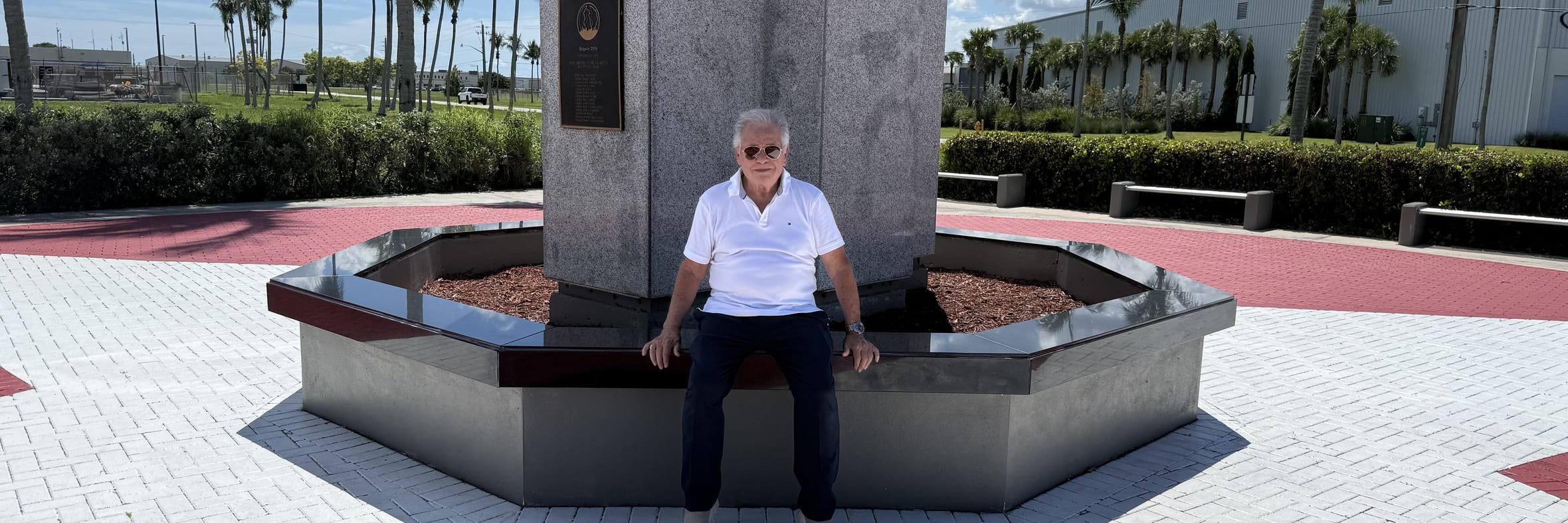
The Bay of Pigs Air Memorial occupies a leased plot at Miami Executive Airport, the field known until recently as Kendall-Tamiami Executive Airport. Its focal point is a B-26 bomber painted in the markings of the Cuban Air Force — the disguise the invasion's aircraft carried in April 1961. Around it are a wall with two flagpoles, plaques naming the men of Brigade 2506 and the project's donors, photographs of the fourteen airmen who were killed, and a granite pillar angled toward the island. The paving is laid as a waving Cuban flag.
This page is built on an interview with Captain Amado Cantillo, president of the Cuban Pilots Association and the memorial's founder, recorded at the site, and on a three-dimensional survey of the memorial made for Preserving Florida in 2025. Where the record is uncertain, the page says so rather than filling the gap.
- Subject headings
- Exile and memory, Civic life
The fourteen airmen
On 17 April 1961, aircraft of Brigade 2506's Liberation Air Force flew against Cuban positions at Bahía de Cochinos. Ten Cuban and four American airmen were killed. Their photographs are mounted at the memorial, and their names are cut into the plaques on the pillar.

Cantillo did not fly that day. Recruited by the Central Intelligence Agency and trained at Vieques, Puerto Rico, he served under the American officer Grayston Lynch and led a group of frogmen due to land at the beach the operation called Blue Beach. Almost nothing went to plan. Sixty years on, where the blame for the failure belongs is still argued.
What was not in doubt, to Cantillo, was what the men were owed. Monuments already stood in Miami for the infantry of Brigade 2506 and for its Navy. None stood for its Liberation Air Force. “When they came back,” he says of the airmen's families, “it was just them.”
We call ourselves brothers. We don't call ourselves comrades like they do, compañeros. We call ourselves brothers.
Finding the aircraft
The B-26 at Miami Executive Airport is eighty-four years old. It was not one of the sixteen aircraft that flew in the invasion: it saw combat in Europe, then in Korea, and ended its working life fighting fires in California. Like the aircraft that flew at Bahía de Cochinos, it is painted to pass as a machine of the Cuban Air Force, the deception meant to allay suspicion during the operation.

The search began with an introduction. A friend, General Pérez, put Cantillo in touch with Major General Charles D. Metcalf, then director of the National Museum of the United States Air Force. Cantillo borrowed the fare to Ohio to meet him. “I could talk to that guy for days. That's how it started. He said, ‘I've got an airplane for you.’”
The aircraft was in California and Cantillo could not afford to go and see it. Metcalf sent him a first-class ticket and arranged for a sergeant to meet him there. When the question became how to move a bomber across the country — Cantillo's own plan involved eight Cubans and a few tractor-trailers, and neither the tools nor the experience — Metcalf again found someone who could do it.
Cantillo was training a helicopter pilot when the call came that the aircraft had arrived. He had allowed a week for the three men who brought it to put it together. They finished in under three days.
Building the memorial
Plans for the memorial were announced in August 1999. When the county first leased Cantillo the ground, it was empty space. The aircraft stood at first on the north side of the airport, then was towed to the site and left on blocks, with no marker.

Construction was then held up. Cantillo describes an official in a Florida fiscal office who blocked the work because the association was connected, as he puts it, to Brothers to the Rescue “and groups that make waves in Cuba”. A Miami Herald photographer caught him at that moment, arms flung wide beside the aircraft. “And I say, ‘Oh man, I can't take anymore.’ I'm praying, ‘God, help me!’ And the truck goes by and takes that picture.” The obstacle was cleared with a letter confirming that the aircraft was for display only.
The pillar was designed by an architect who worked without a fee and refused to be named at the site. “I had more or less an idea of what I wanted — pointing toward Cuba,” Cantillo says. The blackboard on one of its faces cost twelve thousand dollars and was donated. The B-26's Cuban markings were painted by hand by Lorenzo Suarez, who works on the upkeep five days a week and who, Cantillo points out, “doesn't like stencils”.
The site today
Fifteen years after the unveiling, the money to keep the memorial in the condition Cantillo believes the dead are owed is still not settled. “To do a little bit costs a lot. Sometimes I don't sleep. I'm a champion sleeper, but I haven't slept in the last six months.” And: “I don't like to owe money — especially because this is a sacred place.” The site has been built and maintained on his own resourcefulness and on the generosity of others, much of it from the Cuban exile community, and he is careful that every donor is named on the plaques.
The Cuban Pilots Association had two hundred and eighty members when Cantillo was elected its president in 1988. It has seven. “I haven't resigned. I got upset, and I told them I would resign. But I'll die here.”
In 2025 Preference Consulting recorded a detailed three-dimensional survey of the site, reaching from the B-26's flight instruments to an overhead view of the Cuban flag laid into the paving. It preserves the memorial as it stands and lets people who cannot travel to Miami Executive Airport see it.
I'm not a hero. I'm not anything. I just did my duty.
The site in 3D
This film has no sound.
Chronology
- Aircraft of Brigade 2506's Liberation Air Force fly against Cuban positions at Bahía de Cochinos. Ten Cuban and four American airmen are killed.
- Amado Cantillo is elected president of the Cuban Pilots Association, which then has two hundred and eighty members.
- The B-26 reaches Miami. Three men sent by the National Museum of the United States Air Force assemble it in under three days.
- Plans for the memorial are announced. Miami-Dade County leases Cantillo an empty plot at what was then Kendall-Tamiami Executive Airport.
- The memorial is unveiled, after construction through the 2000s. The pillar, the plaques and the Cuban flag laid into the paving are in place.
- Preference Consulting records a three-dimensional survey of the memorial for Preserving Florida.
